What needed solving.
How I built it.
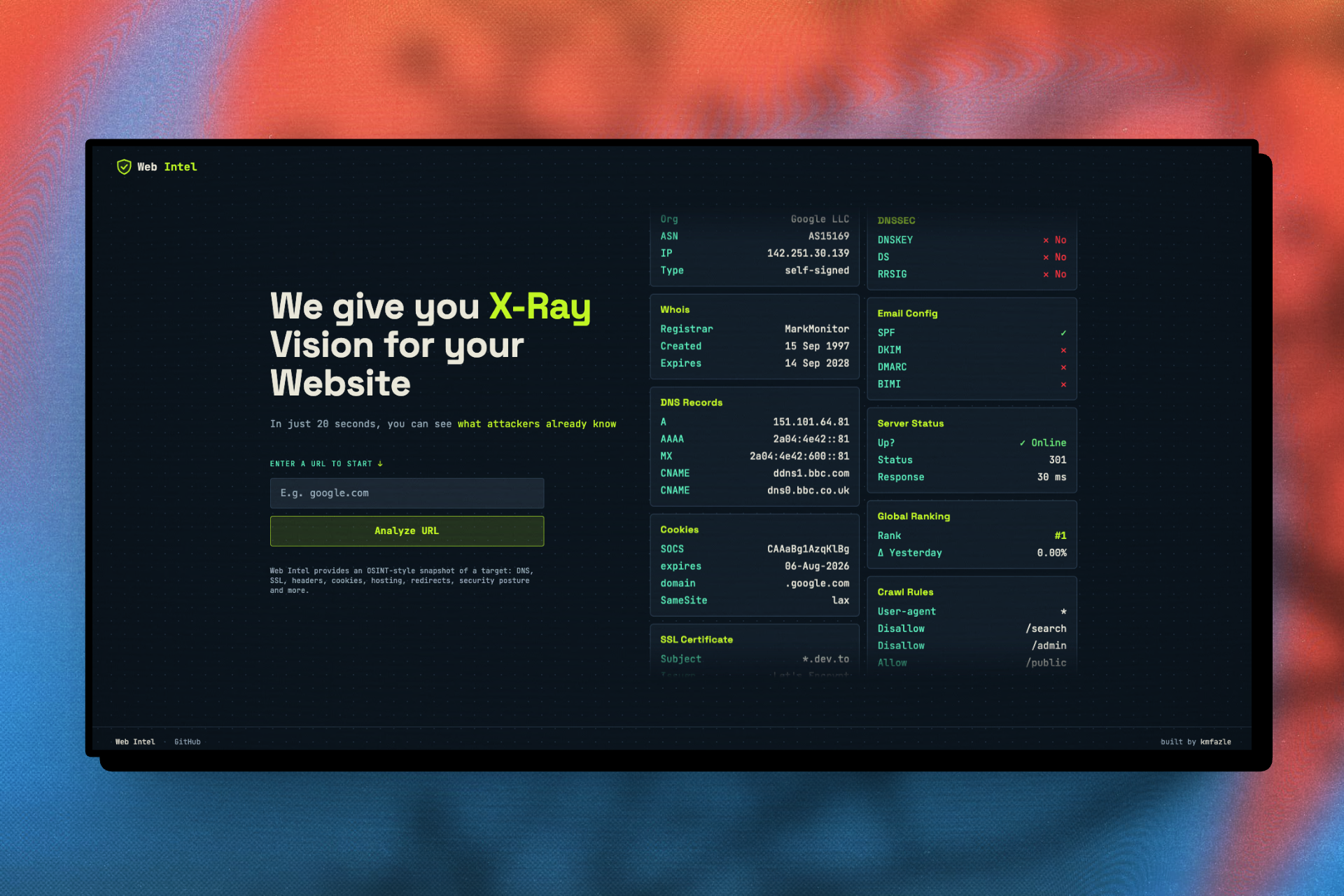
Web Intel gives developers and security-minded users a fast, read-only snapshot of what is publicly visible about a domain. The app runs parallel OSINT checks for DNS, SSL, headers, geolocation, archive history, crawl rules, and related signals, then surfaces an advisory panel for security issues and warnings. External tool deep-links pre-fill the analyzed domain for follow-up in VirusTotal, Shodan, SSL Labs, and similar services. The project is open source under MIT with CI and deployment guides for Vercel and Cloudflare.
- 01Built as a full-stack TanStack Start app with SSR, server functions, and file-based routing so checks run server-side while keeping the UI responsive and shareable.
- 02Parallelized independent OSINT lookups to reduce total report latency instead of running checks sequentially.
- 03Kept core checks free of third-party API keys so the tool stays usable out of the box, while deep-links hand off to specialized external services when deeper analysis is needed.
What it does.
Runs DNS, SSL, security headers, geolocation, archive, crawl rules, and related public-signal checks in parallel and returns a structured report in one view.
Highlights missing headers, certificate issues, and other warnings in a focused advisory panel so reviewers can triage risk quickly.
Pre-fills analyzed domains into VirusTotal, Shodan, SSL Labs, and other external tools for deeper follow-up without retyping the target.
Full feature list (6 more)
- 01DNSSEC, SPF, DMARC, and email-related checks
- 02Social meta tags and linked page discovery
- 03Wayback archive and carbon estimate signals
- 04WAF hints and RDAP domain WHOIS lookups
- 05Deployment guides for Vercel and Cloudflare Workers
- 06GitHub Actions CI for linting and build verification
What it shipped.
Shipped as a live open-source app with a focused dark UI and fast domain analysis flow. The project demonstrates how to combine SSR, server-side recon logic, and practical security UX in a tool that is useful for developers, reviewers, and risk-minded teams doing first-pass domain triage.
Built with.
FastAPI-inspired REST framework, published to PyPI, built to understand framework internals from the ground up.