What needed solving.
How I built it.
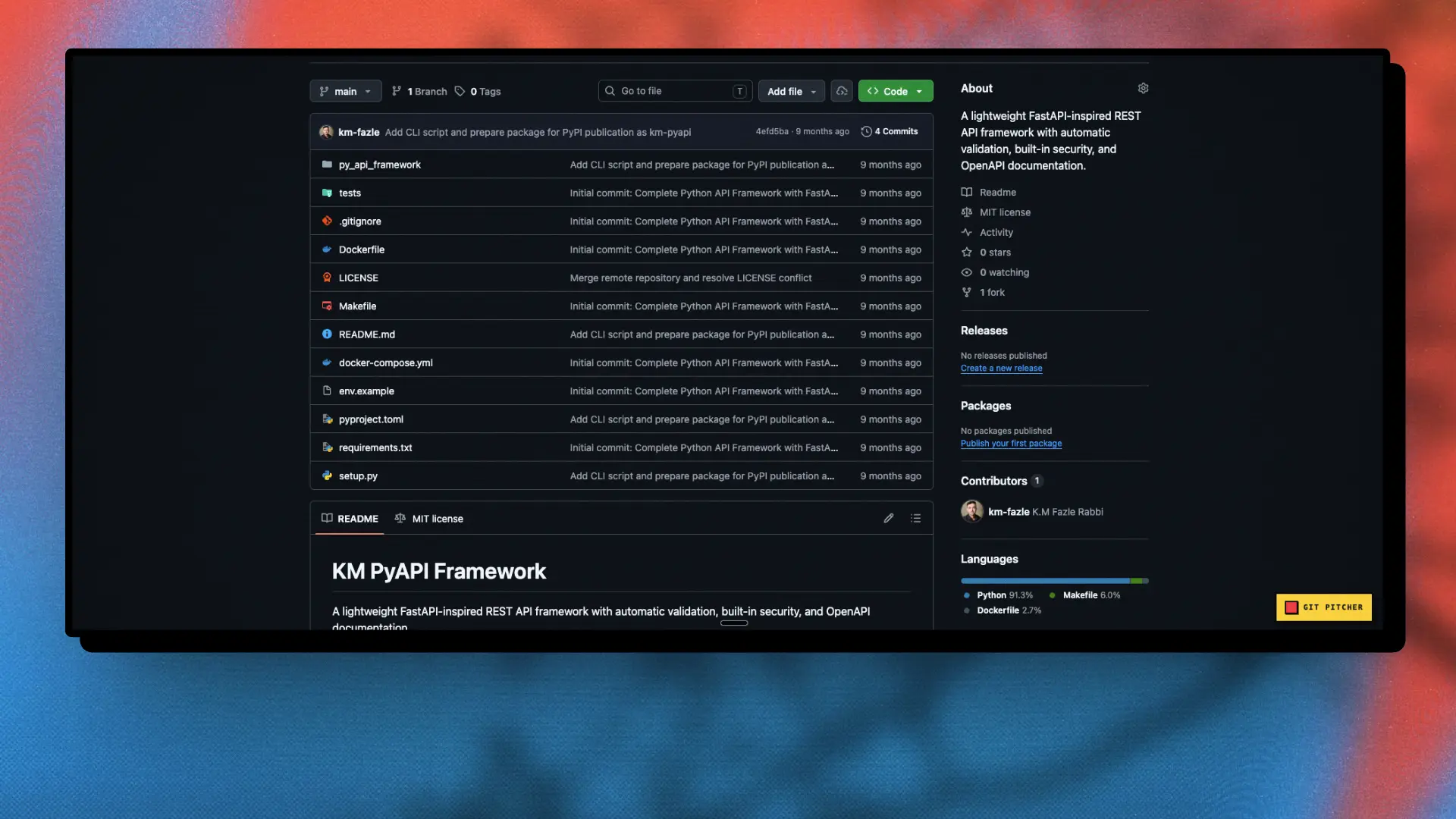
km-pyapi is a FastAPI-inspired REST framework distributed on PyPI. It implements its own routing layer, request validation, JWT auth, SQLAlchemy ORM integration, OpenAPI-style documentation, password hashing and CORS, packaged with Docker deployment and a Pytest suite so others can use it as a learning reference too.
- 01Built the routing layer from scratch using a radix-tree-inspired approach to understand how path matching and parameter extraction work before reaching for an existing router.
- 02JWT auth is implemented without a framework helper to expose the token issuance, verification and expiry logic explicitly, the code is intentionally readable over optimized.
- 03Published to PyPI early (before full feature parity) to practice the packaging and release workflow as part of the learning objective.
What it does.
Path matching, parameter extraction and method dispatch implemented from scratch, no ASGI/WSGI framework underneath, just Python.
Full auth flow with token issuance, verification and expiry, plus SQLAlchemy integration for model definition and query execution.
Auto-generated endpoint documentation and a test suite covering routing, auth and validation, making it usable as a learning reference, not just a demo.
Full feature list (4 more)
- 01Request validation
- 02Password hashing
- 03CORS support
- 04Docker-ready deployment
What it shipped.
Published to PyPI. The project deepened my understanding of routing internals, WSGI mechanics, and how auth middleware is layered, knowledge that directly informs how I build and debug production FastAPI services. Occasional GitHub stars from other engineers learning Python internals.
Built with.
Research on autonomous multi-agent AI systems for end-to-end workflow automation in U.S. private security.