Autonomous Security AI
Research on autonomous multi-agent AI systems for end-to-end workflow automation in U.S. private security.
What needed solving.
How I built it.
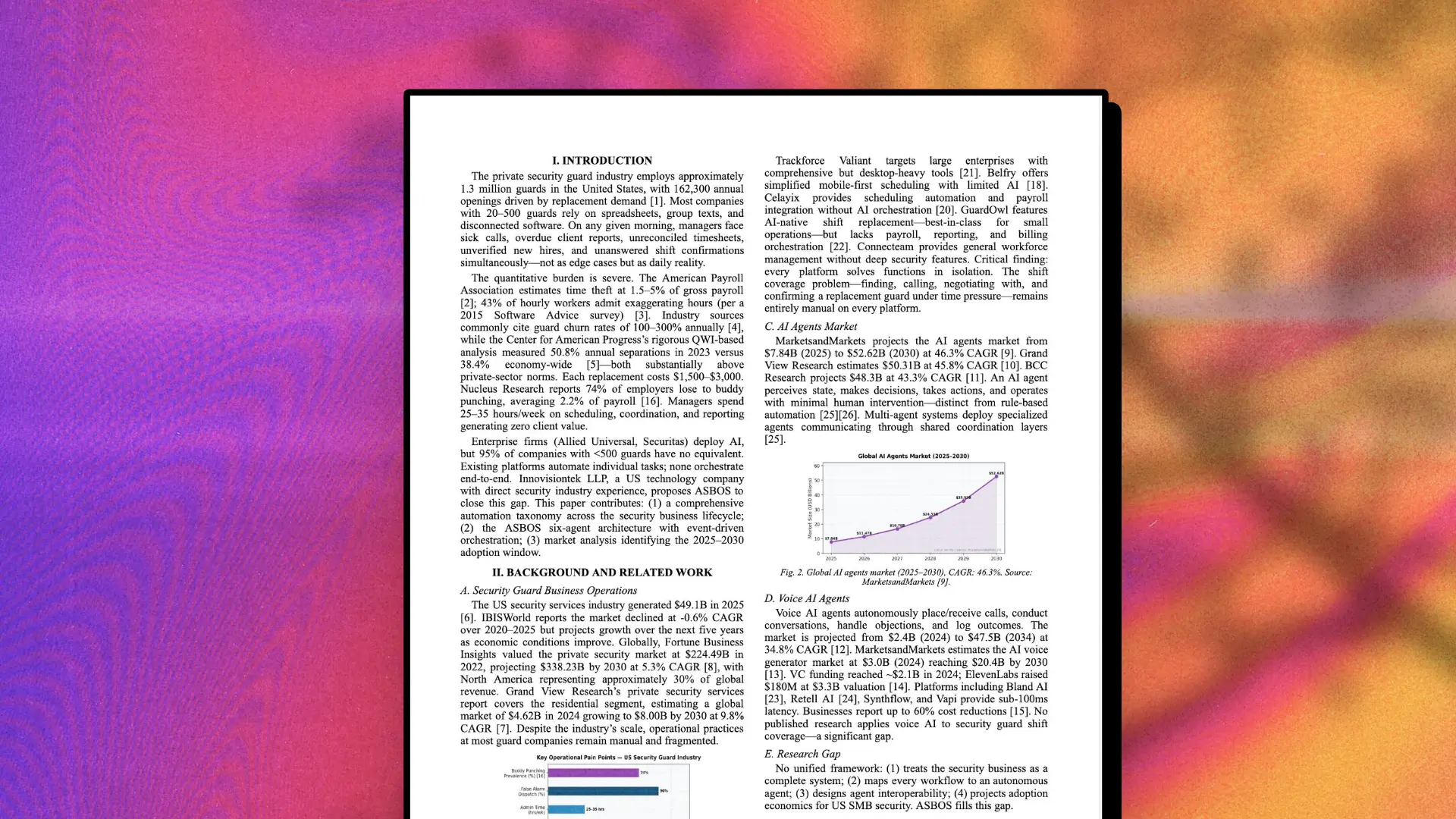
Co-authored research under Innovisiontek exploring how multi-agent AI systems can automate end-to-end workflows in private security. The work models dispatcher, guard, reporting and scheduling agents as cooperating roles, and proposes a vertical-SaaS pattern for applying agentic AI to operations-heavy industries.
- 01Modeled each operational role (dispatcher, guard, scheduler, report-writer) as a distinct agent with a bounded tool set rather than a single general agent, tighter scope made each agent's behavior predictable and auditable.
- 02Proposed a human-in-the-loop checkpoint at shift assignment and incident escalation rather than full autonomy, security operations have legal liability consequences that require a named human to be accountable.
- 03The vertical-SaaS framing was chosen deliberately: a domain-specific agent system can encode compliance rules, shift law and client contract constraints that a horizontal tool cannot.
What it does.
Five cooperating agent roles, dispatcher, guard, scheduler, report-writer and client-comms, each with a bounded tool set and defined handoff protocol.
Critical decisions (incident escalation, shift reassignment after a no-show) route to a human checkpoint rather than autonomous resolution, preserving legal accountability.
Proposes a packaging model for taking domain-specific agentic AI to market as a vertical SaaS product rather than a generic automation layer.
What it shipped.
Research completed and published under Innovisiontek. The dispatcher-agent model directly informed the architecture of Signalix's real-time dispatch features. The human-in-the-loop framework became a reference point for decisions about what Signalix should automate vs. surface for human review.
Built with.
AI repo-to-product planner that turns any GitHub repo into pitch docs, PRDs, audits and prompt packs.