GitPitcher
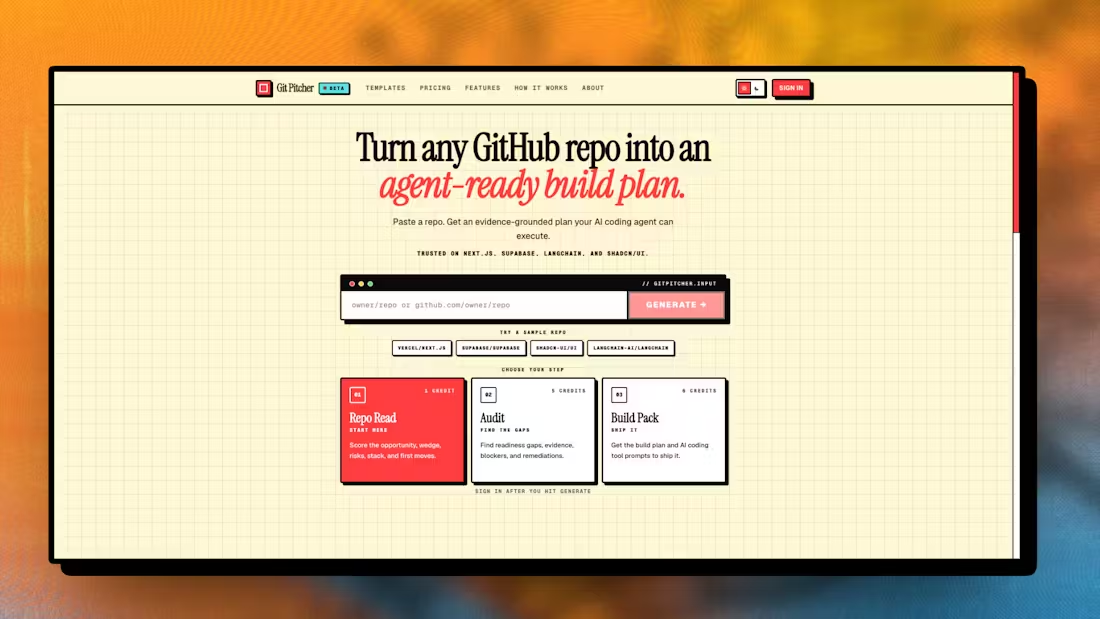
AI repo-to-product planner that turns any GitHub repo into pitch docs, PRDs, audits and prompt packs.
What needed solving.
How I built it.
GitPitcher takes any public GitHub repository, walks the codebase with the GitHub API and an LLM pipeline, and generates a coordinated set of artifacts, pitch documents, PRDs, codebase audits, execution packs and prompt packs. Outputs are versioned, shareable as public pages, and exportable to PDF. A credit-based usage model keeps inference costs predictable, and product analytics drive iteration on what founders actually open.
- 01Chose a credit model over subscriptions to keep per-user inference costs bounded, each artifact type has a fixed credit cost derived from its token profile, so margins stay predictable at scale.
- 02Streamed LLM output progressively so users see artifacts being written in real time rather than waiting 30–60 seconds for a static result, critical for perceived performance with slow completions.
- 03Built a thin caching layer on GitHub API responses to avoid re-fetching the same repo tree on repeat runs, cutting both latency and API quota usage by ~60% for returning users.
What it does.
Feed any public GitHub URL and receive a coordinated set of outputs, pitch doc, PRD, codebase audit, execution pack and prompt pack, generated from the actual source code.
Every artifact generates a shareable public URL and can be exported to PDF, making it easy to hand off to investors, co-founders or AI coding tools.
Usage is metered in credits so inference costs stay predictable. Integrated with Stripe for top-ups and PostHog for funnel analytics.
Full feature list (4 more)
- 01GitHub repository analysis via GitHub API
- 02Prompt pack generation for AI coding tools
- 03Versioned artifact history
- 04Product analytics with PostHog
What it shipped.
Launched publicly and ranked #45 on Product Hunt on launch day. The pipeline reliably produces usable artifacts in under 60 seconds for most repositories. Early users were primarily indie hackers and solo founders using it to pitch AI-generated projects. Execution packs, not pitches, had the highest re-open rate, which drove subsequent prioritization.
Built with.
Multi-tenant platform for private security companies, guards, schedules, incidents, GPS clock-in and live field operations.