Nullcase
AI interview simulation for software engineers, realistic coding prompts, AI-driven feedback and structured prep workflows.
What needed solving.
How I built it.
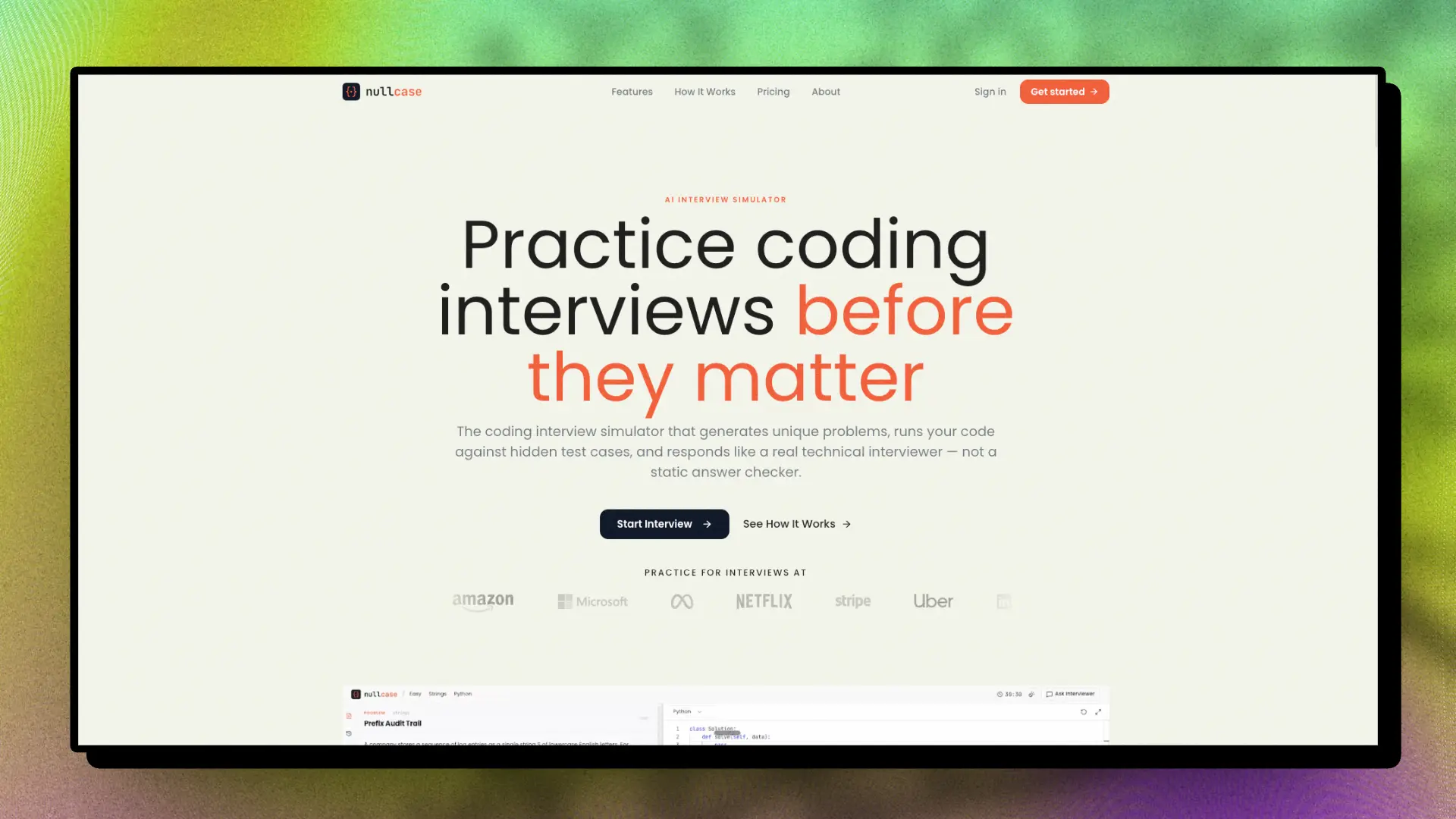
Nullcase puts engineers inside an interview-shaped loop. The AI plays interviewer: it sets a prompt, asks clarifying questions, watches your approach and gives structured feedback on both correctness and communication. The product is intentionally narrow, not a question bank, but a deliberate practice tool focused on interview pressure.
- 01Kept the product scope deliberately narrow, no question bank, no leaderboard, no streak gamification, to ship a focused loop that replicates actual interview pressure rather than passive browsing.
- 02AI feedback is structured with explicit rubric dimensions (communication, correctness, edge-case coverage) so users receive actionable notes rather than vague responses.
- 03Streamed the AI interviewer's responses token-by-token to maintain the feel of a real conversation rather than a batch-load response that breaks the simulation frame.
What it does.
The AI plays an active interviewer, it sets the problem, asks clarifying questions mid-solve, and probes your reasoning, not just your output.
After each session, you receive feedback across explicit dimensions: problem understanding, code correctness, edge case coverage, and how well you communicated your approach.
Every session is self-contained and time-boxed, designed to build the specific muscle of performing under interview conditions, not just knowing algorithms.
Full feature list (3 more)
- 01Coding challenge practice
- 02Real-time AI-driven feedback
- 03Developer-focused practice workflow
What it shipped.
Launched publicly. The structured feedback format, rubric-driven rather than free-form, was the most-cited differentiator in early user responses. Engineers want to practice communication as much as correctness, which validated the interview-simulation framing over a traditional problem-bank approach.
Built with.
AI-powered knowledge workspace that lets you chat with PDFs, notes and URLs via retrieval-augmented generation.